Last update: June 2026. The information in this article is regularly checked against official sources from the Government of Andorra.
📊 Key data (2025–2026)
- Cross-border workers in Andorra: >10,000 — close to 20 % of the assets (CASS, 2025)
- Distance La Seu d'Urgell–Andorra la Vella: ~25 km (30–40 min by car)
- Andorra-Spain Social Security Agreement: allows contributions to the CASS while maintaining Spanish benefits (BOE, 2019)
- ISI (Andorran IRPF) for cross-border residents in Spain: 10 % maximum; CDI avoids double taxation (Tributes, 2026)
- Cross-border plan 2026: €35M in transport infrastructure Alt Urgell–Andorra (Govern, 2026)
If you're thinking about changing your career path and looking for a dynamic destination with excellent job opportunities, you've probably set your sights on the north. Andorra, thanks to its thriving economy, security, and enviable natural environment, has become one of the most powerful magnets for talent in the Pyrenees. However, physically relocating to a country of just 468 square kilometers isn't always the ideal or feasible option for everyone, due to space or lifestyle considerations. This is where the role of the [unclear - possibly "coach" or "coach"] becomes undeniably important. cross-border workers Andorra.
During the 37th Pyrenees Business Meeting in La Seu d'Urgell, the political and labor landscape of this border region took a significant step forward. The President of the Generalitat of Catalonia, Salvador Illa, emphasized the urgent need to jointly address the daily challenges faced by this group of workers and to strengthen bilateral cooperation. For those planning to make the move or already experiencing this reality daily, these developments open up a new scenario brimming with opportunities, logistical improvements, and potential tax changes that you should be fully aware of.
The new era of relations between Catalonia and Andorra
The Pyrenees should not be seen as a border or an insurmountable obstacle, but as a first-rate socio-economic meeting point. This has become clearer than ever after the debates held at the Pyrenees Business Meeting, a key annual event where political leaders, executives, and businesspeople analyze the future of the mountain region. The conclusions of the presentations point to a clear change of course: Catalonia-Andorra relations They are currently experiencing a moment of maximum institutional harmony and mutual understanding.
The Catalan president, Salvador Illa, emphasized that the commitment to understanding between the two administrations is absolute. We are not talking merely about empty words or institutional diplomacy for show, but about a firm commitment to establishing bilateral working groups and maintaining close contact with other neighboring regions, such as Occitanie in France. The objective is clear: to treat the Pyrenees as a single, coordinated economic bioregion.
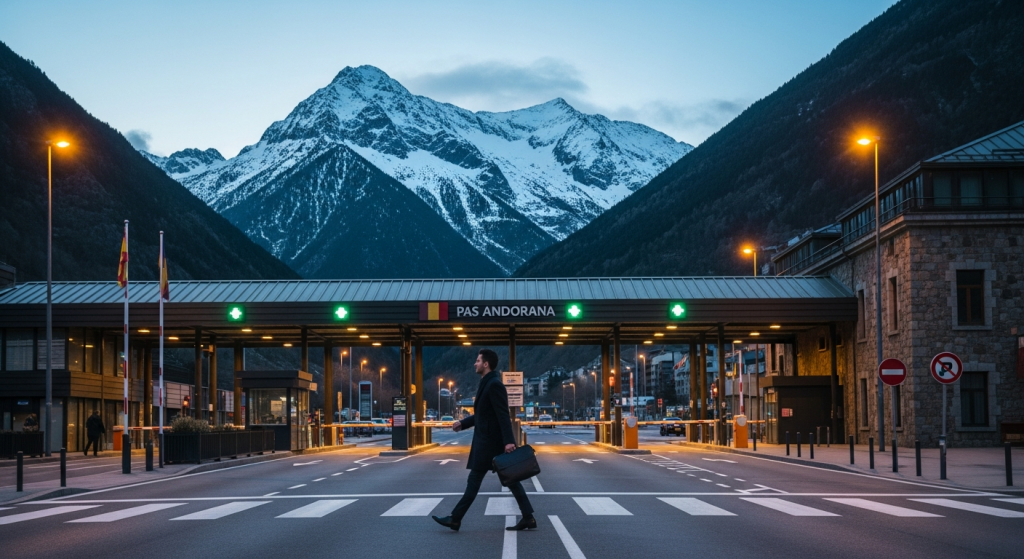
For foreign professionals and those from mainland Spain considering settling in the border regions, this political rapprochement is a huge relief. Historically, living in one country and working in another meant facing a regulatory vacuum or slow and cumbersome bureaucracy. The current institutional harmony ensures that real problems—such as queues at the Farga de Moles customs office, social security procedures, and the validation of qualifications—are placed at the center of the political agenda to find swift solutions.
What solutions are proposed for cross-border workers in 2026?
The alternative of work in Andorra live in Spain It has become established as one of the best options for thousands of people. It allows them to enjoy the competitive salaries of the dynamic Andorran labor market while maintaining residency in Spain, benefiting from a potentially more affordable cost of living in certain areas of the Catalan Pyrenees, as well as continuous access to Spanish public services.
Despite these undeniable advantages, the day-to-day life of the cross-border workers Andorra It is not without practical difficulties. Inefficient public transport between the towns of Alt Urgell and the various Andorran parishes, traffic jams during peak commuting hours, and recurring questions about pension contributions are constant concerns. Faced with this situation, the Catalan government and the Spanish government have announced that they are already working together to design specific support mechanisms for this group.
Although specific technical measures to prevent speculation have not been detailed, the institutional approach focuses on three fundamental pillars:
- Improvements in communication and transport networks: The plan is to optimize the frequency and fares of cross-border bus lines to offer a real, ecological and economical alternative to the private car.
- Streamlining bureaucratic procedures: Creation of direct communication channels to facilitate obtaining temporary and cross-border work permits without creating a bureaucratic nightmare for the employee or the hiring company.
- Social protection guarantees: Technical coordination to ensure that contributions made to the Andorran Social Security Fund (CASS) are automatically and transparently recognized and validated in the Spanish pension system.
The housing problem: The pressure is shifting beyond La Seu d'Urgell
Andorra's extraordinary economic growth and its consolidation as a residential destination for investors and digital professionals have led to unprecedented pressure on the real estate market within its borders. With a very limited supply of land due to the country's topography, rental and purchase prices in the Principality have risen significantly in recent years.
As if they were communicating vessels, this situation has shifted residential demand directly to neighboring Spanish territory. However, finding a housing in La Seu d'Urgell This has become a major challenge. The rental market in the capital of Alt Urgell is practically saturated, and prices have risen, making it difficult for both new workers and long-time local residents to find housing.
Authorities are already warning that this high demand for housing linked to workers from Andorra is not limited exclusively to La Seu d'Urgell, but is shifting real estate pressure to other neighboring municipalities in the region, such as Alàs, Ribera d'Urgellet, Montferrer, and Organyà. To prevent depopulation and gentrification in these beautiful mountain areas, an urgent call for bilateral cooperation has been made. The proposed solutions include incentivizing the construction of affordable housing developments and creating mediation programs that encourage owners of vacant properties in the Pyrenees to put them on the long-term rental market with full legal guarantees.
Future specific tax regime for the Pyrenees
One of the most innovative proposals to emerge from the recent business meeting is the study and development of a specific tax regime for the Pyrenees regions. This tool could drastically transform the economic landscape for all those residing on the Spanish side of the border.
The feasibility of implementing a taxation Pyrenees Andorra This differentiated and advantageous tax framework has the primary objective of offsetting the added costs faced by mountain areas (depopulation, transportation difficulties, harsh winter weather) and promoting talent retention in Catalonia. For professionals, the self-employed, and micro-enterprises, this adapted tax framework would entail a series of tax incentives, personal income tax deductions, and reductions in social security contributions.
By providing border regions with their own tax incentives, the aim is to revitalize the local economy and prevent them from becoming merely commuter towns for Andorran workers. This more favorable tax environment would encourage the creation of local service companies, consultancies, technology projects, and sustainable tourism ventures that would directly support the Andorran economy, generating a valuable business feedback loop on both sides of the border.
Geopolitics, technology and sustainability: The European context of the border
The future of the Pyrenees is not decided solely at the local level; it is intrinsically linked to major global geopolitical and technological trends. During his presentations, Salvador Illa emphasized that we are facing a profound shift on a global scale, marked by the climate emergency, the energy transition, and the unstoppable emergence of new technologies.
Faced with the highly competitive and deregulated development models of other superpowers, Europe defends its own model, one that does not forgo economic prosperity but firmly prioritizes social rights, community cohesion, and scrupulous respect for the environment. On the Catalan-Andorran border, this European model will translate primarily into two main lines of action for the coming years:
1. Self-sufficiency and energy transition
The availability and cost of energy will be key factors in the competitiveness of businesses in the Pyrenees. A phased rollout of renewable energy sources—such as solar photovoltaics, forest biomass, and small-scale hydropower—is planned to ensure that both homes and businesses in the mountains have access to clean, locally sourced energy at stable and predictable prices.
2. Integration and regulation of Artificial Intelligence
Advanced digitization and the use of Artificial Intelligence will profoundly transform the employment structure across all sectors, from the administrative management of cross-border workers to tourism and commercial services. The commitment of public administrations is to ensure that this technological transition takes place within an ethical framework that protects workers' rights, promotes the continuous training of professionals, and serves to increase productivity and the overall well-being of mountain regions.
Those who decide to invest in this vibrant border region will find a territory in full transformation that, far from being intimidated by global challenges, is joining forces to build a more prosperous, integrated, sustainable future full of opportunities for all.