Last update: June 2026
📊 Key data (2025–2026)
- Vehicle entry in May 2026: 328,226 units — fall of 3,0 % year-on-year (Andorra Statistics)
- Main access points: N-22 (Spain) Y RN-22 (France)
- Andorra receives more than 3 million tourists/yearThe car is the most used means of transport
- Electric vehicle registrations in Andorra: +40 % in 2025
- Public parking in Andorra la Vella: +8,000 places available
Traffic analysis in Andorra: Drop in vehicle entry on the 31st and 33rd.
If you're thinking of organizing a trip to the Principality or even if you're planning to settle here, there's one indicator you should always keep a close eye on: traffic and access trends. The most recent data published by the Andorran Department of Statistics reveals a rather striking change in the vehicle entry into Andorra during the past month of May 2026. In total, the country registered access to 328,226 vehicles, which represents a decrease of 3.0% compared to the same month of the previous year.
When we analyze this decline by mode of transport, we see that the drop is primarily driven by private cars. Passenger car traffic fell by 3.11%, while heavy goods vehicle traffic (such as delivery trucks and buses) remained virtually flat, with an almost imperceptible variation of -0.11%. This indicates that, although wholesale trade and the country's supply chain continue to operate at full capacity, the flow of private visitors has experienced a slight slowdown.
If we broaden our perspective and analyze the behavior of Andorra traffic 2026 So far this year (the cumulative total from January to May), the downward trend is even more evident. During the first five months of this year, the overall number of vehicles entering the Principality shows a 6.0% decline compared to the same period in 2025. This data forces us to analyze closely what is happening at each of the access points to the country, since the behavior is not the same in the south as in the north.
Border with Spain vs. Border with France: Two opposing realities
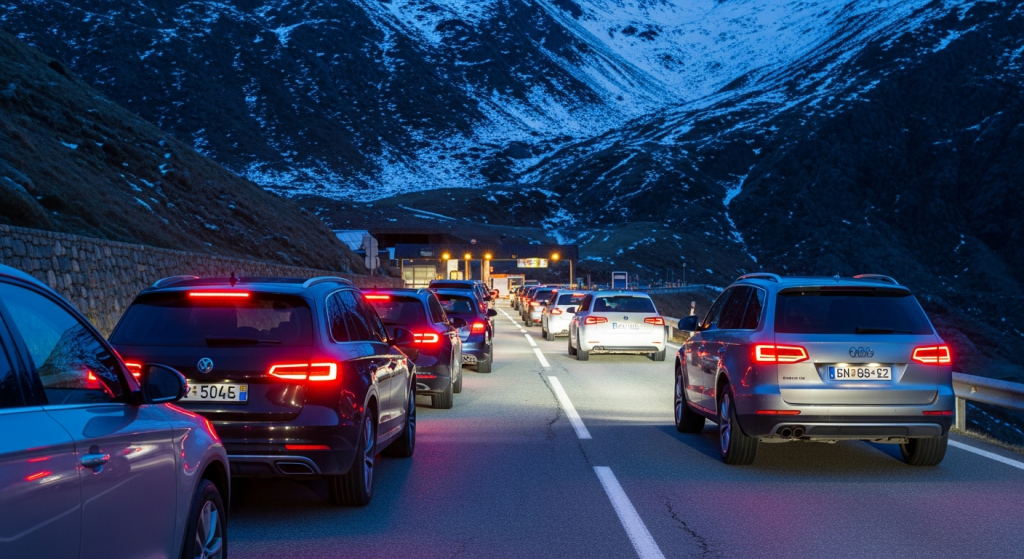
Andorra is a Pyrenean country nestled between two giants, meaning there are only two road entry points: the southern border (with Spain, via La Farga de Moles) and the northern border (with France, via Pas de la Casa). Recent data shows that these two routes are currently experiencing completely opposite situations.
Stability and solidity on the Andorra-Spain border
The connection with Spain continues to show robust health. During May, passenger car traffic from the Spanish side barely changed, registering a very slight decrease of 0.21%. But what is truly interesting is the year-to-date figure from January to May 2026: vehicle entries from Spain have experienced a positive growth of 1.4%.
Furthermore, heavy vehicle traffic through this point increased by 0.71% in May, consolidating the Andorra-Spain border as the main and most stable access route for supplies, cross-border workers and medium and long stay tourism arriving from the Iberian Peninsula.
Sharp collapse on the Andorra-France border
The situation at the northern access point is radically different and explains the overall drop in the country's statistics. Cars coming from France suffered a 9.1% collapse only during the month of May. If we look at the cumulative performance between January and May 2026, the drop is even more alarming, reaching a 23.2% pullback compared to the previous year.
This decline has also been felt in heavy goods vehicles on the French side, which fell by 4.01% in May and registered a dramatic drop of 37.71% in heavy goods vehicle departures to the neighboring country. Clearly, the Pas de la Casa border crossing is experiencing a very severe adjustment in activity.
How is the total traffic volume distributed?
Despite these fluctuations, the dimensions of both access points remain highly unbalanced. To give you an idea of the actual volume of cars traveling on the roads of the Principality, a total of [number missing] have entered the country in the last twelve months. 4,075,792 vehiclesIts distribution gives us a very clear picture of Andorran mobility:
- Along the Spanish-Andorran border: 2,919,034 vehicles accessed (approximately 71.61% of the total).
- Along the Franco-Andorran border: 1,156,758 vehicles accessed (the remaining 28.4%).
As for departures from the country, the trend is identical. Over the past twelve months, 4,030,583 vehicles left Andorra (2,879,528 via Spain and 1,151,055 via France), confirming that the Spanish border remains by far the preferred route for drivers.
What is the reason for the decrease in visitors and day-trippers in the Principality?
To understand these traffic figures, we can't just look at the number of cars; we need to look at who's inside them. The key to this 3% drop in entries lies in a very specific visitor profile: the day hiker.
Day-trippers (those visitors who come to spend the day shopping, sightseeing, or eating, but who do not stay overnight in Andorran hotels) represent almost 701% of the total volume of tourists received by the country. During the month of May, the influx of this group of day-trippers... It fell by 5.4% compared to the previous year. As the largest group, any small change in their behavior has a direct and immediate impact on the roads.
What factors explain this slowdown in domestic tourism, especially in the north? Experts point to several combined reasons:
- Inflation and the cost of living in France: The loss of purchasing power in the south of France has led many citizens to reduce weekend trips intended purely for shopping in Pas de la Casa.
- Stricter customs and police controls: The increase in inspections at French customs discourages drivers who used to regularly go there for tobacco and alcohol, due to the delays caused by these checks.
- Meteorological factors: Spring 2026 has been marked by notable weather instability in the northern mountain passes, which always deters the day driver who prefers not to take risks on the road.
However, it's not all bad news for the sector. If we analyze the adjusted monthly data (that is, removing calendar effects, Easter holidays, and the seasonality of spring), the underlying trend of the last five months shows a upward recovery of 3.7% at the vehicle entrance. This means that, once we clean up the "noise" from the monthly data, the real interest of foreigners in visiting the Principality remains very strong.
Guide for foreign drivers: How to travel to Andorra by car in 2026
If after seeing this data you are planning travel to Andorra by car Soon, it is essential that you know how our borders work and the local traffic rules to avoid setbacks, fines or long waits on the road.
Required documentation at customs
Andorra is not part of the Schengen Area, although it has special free movement agreements with its neighbors. This means that when crossing both the Spanish and French borders, you will encounter customs checkpoints. To enter the country by car, you must carry the following:
- Identity document: Valid ID or passport for all vehicle occupants (including children). If you are from outside the European Union, check if you need a multiple-entry visa to re-enter Spain or France after your visit to Andorra.
- Driver's license: Your valid driving license from your country of origin.
- Car documents: Vehicle registration document and MOT up to date.
- Green Card insurance: Although it is no longer strictly mandatory for vehicles registered in the European Union to carry the physical Green Card (since computer systems check civil liability coverage), it is highly recommended to carry it printed or in digital format to avoid unnecessary delays at any checkpoint by the Andorran Police or in case of an accident.
Tips to avoid traffic jams at borders
If you want to avoid spending hours stopped on the road, especially at the La Farga de Moles customs checkpoint, we recommend applying the following timing guidelines based on the experience of residents:
- Avoid peak entry times: On Fridays from 5:00 PM onwards and on Saturday mornings (from 9:00 AM to 1:30 PM) there are usually long queues for entry from Spain.
- Plan your departure in advance: Sunday afternoons (from 3:00 PM until late at night) are the worst time to leave the country. If possible, move your departure to Sunday morning or postpone it to Monday.
- Check real-time traffic: The Andorran Department of Mobility offers a mobile application and an official website where you can view live border camera feeds before you set off.
Driving regulations in Andorra
Driving in the Principality is very safe, but traffic laws are strict and the mountainous terrain demands extra caution. Keep these key rules in mind:
- Speed limits: In urban areas the speed limit is usually 30 km/h or 50 km/h, while on main roads the maximum allowed is 90 km/h. There are numerous fixed and average speed cameras monitoring these speeds.
- Winter equipment (Traffic Law): Although it's not necessary during the summer months, remember that from November 1st to May 15th it is mandatory Carry winter tires or snow chains in your trunk. Fines for blocking the road due to lack of winter equipment are severe.
- Commercial franchises (Customs): Andorra is a famous destination for duty-free shopping, but there are strict limits on the amount of goods you can take out of the country without declaring them at customs (for example: a maximum of 300 cigarettes, 1.5 liters of alcohol over 22% ABV, and up to €900 in general purchases per adult). Exceeding these limits without declaring goods can result in substantial fines and confiscation of the merchandise.
In conclusion, traffic patterns and access during 2026 reflect a shift in the habits of French visitors and a relatively stable flow of travelers crossing from Spain. If you plan to travel on our roads, careful planning will ensure a smooth and uneventful journey in this unique corner of the Pyrenees.
Frequently Asked Questions (FAQ)
Which is the most recommended border crossing to enter Andorra?
The border crossing with Spain (La Farga de Moles, in Lleida) is the most recommended for the vast majority of travelers. It is the busiest access point, accounting for over 711,000 tons of the country's annual traffic, and has a wider road with fewer sharp curves than the access from France. Furthermore, it is not closed due to snow as frequently during the winter.
Why has the number of vehicles entering through the French border decreased so much?
The cumulative decrease of 23.21% in 2016 across the French border is primarily due to a change in the behavior of French day-trippers. The loss of purchasing power due to inflation in southern France, coupled with stricter French customs controls and unstable spring weather in the mountain passes, has deterred many regular visitors to the Pas de la Casa shopping area.
What documentation is needed to cross the Andorra border by car?
It is essential that all vehicle occupants carry their original and valid ID card or passport. For the car, the vehicle registration document, the technical data sheet with a current MOT/vehicle inspection certificate, and, although it is not always physically requested from citizens of the European Union, it is highly recommended to carry the Green Card of car insurance to prove coverage in case of an accident.
What is the trend for road tourism in Andorra by the end of 2026?
Although the raw year-on-year figures show a decline, the seasonally adjusted monthly trend for traffic over the last five months shows a clear upward recovery of 3.71% in vehicle entries. This indicates that interest in the Principality remains strong and suggests a positive rebound in visitor numbers for the upcoming summer season and the peak ski season.