Last update: June 2026
📊 Key data (2025–2026)
- Surface of the Madriu-Perafita-Claror Cultural Landscape: 4,247 ha (UNESCO, 2004)
- Number of sheep in the flock in 2026: 300 female sheep
- Altitude of the Vall del Madriu: between 1,050 my 2,963 m above sea level
- Andorra: only nation in the world declared entirely a Biosphere Reserve by UNESCO
- Duration of transhumance in the Vall: June–September (alpine summer)
The return of transhumance to the Vall del Madriu in 2026
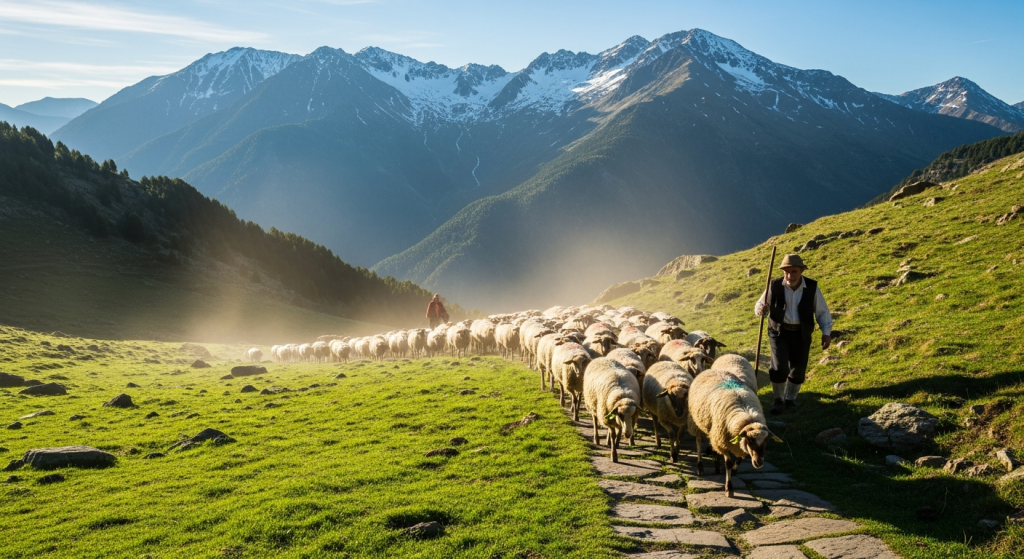
If you've ever hiked the trails of Andorra in early summer, you'll know that the silence of the high mountains is one of its greatest treasures. However, this year, that silence will be accompanied by a traditional sound that many thought was lost: the bleating of sheep and the tinkling of cowbells. In a joint effort to recover historical heritage and protect the Pyrenean ecosystem, the Vall del Madriu Andorra has welcomed a flock of 300 female sheep.
This flock is not local; the sheep have made a very special cross-border journey. Originating from the neighboring French region of Ariège, the animals crossed the border at Pas de la Casa at the end of June 2026, beginning their journey to transhumance Andorra towards the fresh pastures of the high mountains. The project has been enthusiastically promoted by the Comú de Escaldes-Engordany, with the direct collaboration of the Department of Agriculture of the Government of Andorra, demonstrating that the public administration is committed to traditional solutions for the challenges of the 21st century.
For those of us who live in the Principality or are thinking of moving here, these kinds of initiatives remind us that Andorra is much more than technology, commerce, and skiing. It is a country with a soul deeply connected to the land, where traditional livestock farming continues to play a fundamental role in the daily management of the territory and in preserving Andorran cultural identity.
A bridge between tradition and modernity
Transhumance is not simply a tourist attraction. For centuries, moving livestock from the low valleys to the high mountain summer pastures was the economic engine of the Pyrenees. By restoring this natural flow of animals, Andorra not only pays homage to its ancestors but also implements an active environmental management strategy in a protected area that requires meticulous care.
Sheep vs. Cows: The secret weapon against forest fires
It's common to see cows and horses grazing peacefully in the meadows of ski resorts or in the Andorran valleys during the summer. However, when it comes to clearing deep in the forest, these animals aren't the most efficient. This is where the physiology and behavior of sheep come into play, turning these 300 sheep into a veritable ecological brigade. fire prevention Andorra.
Unlike cows and horses, which prefer open, flat pastures, sheep are agile animals that are not afraid to venture into the densest, steepest, and most enclosed areas of the forest. Their ability to access the undergrowth and devour the brush, low shrubs, and dry branches is unmatched. By clearing this accumulated vegetation, sheep eliminate the natural fuel that often spreads wildfires uncontrollably during the summer months.
This work is especially critical in 2026, a year marked by very high summer temperatures across Europe. Climate change is hitting mountain regions hard, forcing us to seek adaptive solutions.
- Thermal relief for animals: In the lowlands of France, temperatures are stifling for livestock. Moving sheep to the high Andorran mountains provides them with the cool, healthy environment they need to thrive.
- Reduction of forest fuel load: Every ton of undergrowth consumed by sheep is one less ton of highly flammable material in the event of a lightning storm or human negligence.
- Stimulation of biodiversity: Controlled grazing helps sunlight reach the forest floor, promoting the growth of new plant species and maintaining the balance of the ecosystem.
La Vall del Madriu-Perafita-Claror: A UNESCO paradise without roads
To understand the importance of this project, we must talk about the scenario in which it takes place: the Vall del Madriu Andorra (specifically the Madriu-Perafita-Claror valley). This impressive natural area covers almost 101% of the country's total surface area and was declared a World Heritage Site by UNESCO in 2004 in the Cultural Landscape category.
What does this mean? It means that it is an environment where human activity and nature have coexisted in perfect harmony for thousands of years. But it also implies a very important peculiarity for its management: There are no roads in Vall del Madriu.You won't see fire trucks, tractors, mechanical brush cutters, or noisy chainsaws working in its deep forests.
Being a protected area with difficult technical access, mechanical forestry work is completely unfeasible. Therefore, sheep grazing becomes the only viable, economical, and sustainable tool. Sustainable tourism in Andorra to keep the forests clean. It's a perfect symbiosis: the animals feed naturally and for free, and in return, they keep the landscape pristine for future generations.
Furthermore, this project stands out for its institutional cooperation. Although the initiative originated with the Comú of Escaldes-Engordany, the flock will move freely through different areas of the valley belonging to other parishes (comunes), demonstrating that environmental protection in Andorra is a joint effort that transcends local administrative boundaries.
Rules of conduct for hikers: What you should know if you visit the area
If you are passionate about nature and are planning to do Hiking in Escaldes-Engordany Or, if you plan to explore the Vall del Madriu during the summer months, you should know that the flock of 300 sheep will remain in the area until the first week of September 2026To ensure that coexistence between humans, domestic dogs and the flock is completely peaceful, the authorities have established a series of very clear guidelines.
Guaranteed safety without guard dogs
In many rural mountain areas, shepherds use mastiffs (large guard dogs) to protect livestock from wolf or bear attacks. However, given that the Vall del Madriu is an area with a high influx of tourists and hikers, the Comú (local council) has decided to Do not include guard dogs in this flock to avoid possible altercations or scares with hikers.
Instead, the shepherds will be accompanied exclusively by purebred working dogs. Border CollieThese dogs are trained solely and exclusively to guide and herd livestock, so they are completely harmless to visitors to the valley.
Your obligations as a visitor and pet owner
The safety of the sheep also depends on us. If you visit the Vall del Madriu with your dog, it is vital that you follow these recommendations to avoid any incidents with the livestock:
- Keep your dog on a leash at all times: Even if your dog is very obedient, the smell and movement of a flock of 300 sheep can awaken its hunting or play instincts, frightening the sheep and causing them to fall off cliffs or scatter.
- Use of a muzzle if necessary: If your dog belongs to a potentially dangerous breed or tends to get nervous around other animals, it is mandatory that it wears a muzzle throughout the journey.
- Maintain a safe distance: If you encounter the flock in the middle of the trail, stop, step aside, and let the shepherds and Border Collies do their job. Enjoy the spectacle calmly and respectfully.
As an additional preventative measure, the Escaldes-Engordany council has reminded residents that the project has specific insurance coverage to cover any incident, accident, or potential attack that the flock might suffer from feral animals or uncontrolled pets. The goal is for the mountains to be a safe space for everyone.
The future of organic grazing in the Andorran Pyrenees
This transhumance project in the Vall del Madriu Andorra This is not an isolated event, but the first step in a long-term strategy to promote Sustainable tourism in Andorra and ecological rural development. The Andorran authorities do not want to make hasty decisions that could disrupt the delicate balance of the territory.
For this reason, rigorous carrying capacity studies were carried out before the livestock were brought up. These reports analyze how much grass and water resources are available in the valley to ensure that the introduction of sheep does not harm local wildlife (such as chamois or isardsnor interfere with the cows and horses that already traditionally graze in the area during the summer.
If the results this summer of 2026 are as positive as expected—both in terms of clearing the undergrowth and coexistence with hikers—the Comú (local council) is already studying the feasibility of adding a second flock of 300 sheep for the coming seasons. This would solidify Andorra's position as a Pyrenean leader in ecological and sustainable forest management, demonstrating that to move forward, sometimes it's necessary to respect the traditions of the past.
If you're planning your next hiking route through the Vall del Madriu in Andorra, remember to respect the environment, follow the marked trails, and keep your pets under control to coexist in harmony with this valuable ecological transhumance project.