Last update: June 2026
📊 Key data (2025–2026)
- Total investment in the La Caubella heliport: 17 million euros
- Operational capacity: helicopters up to 12 tons
- Annual emergency medical flights: ~200 interventions/year (Cos de Bombers, 2025)
- Reduction of air traffic over Andorra la Vella: ~60 % expected
- Location: La Caubella, La Massana — approx. 4 km from the center
Inauguration of the La Caubella Heliport: A Milestone in Andorra's Mobility
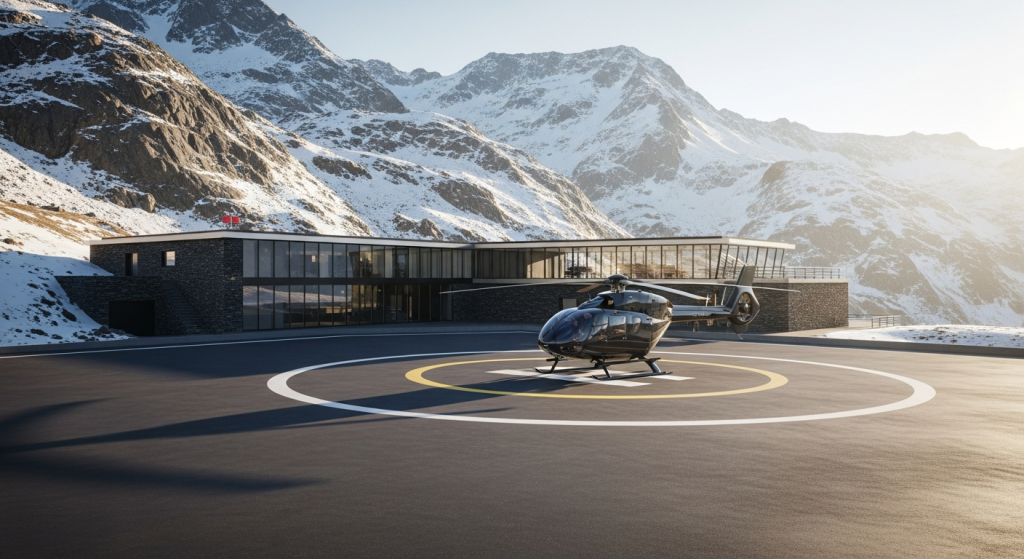
Today, Monday, June 22, 2026, is a day circled in red on the calendar of the Principality. After years of debates, projects, and high expectations, the Andorra's new heliportLocated in the La Caubella area (La Massana), it officially opens its doors. This infrastructure is not just another public works project; it represents a turning point for the area. transport in Andorra and, above all, for the quality of life of residents in urban areas.
Historically, helicopter activity in the country was very dispersed and, at times, too close to the areas where people live, sleep, and work. With the implementation of the Caubella heliportMost domestic air traffic will be relocated away from residential areas. This means that daily takeoffs and landings, both emergency and commercial, will be concentrated in a well-prepared mountain environment, drastically reducing noise pollution in town centers.
The mayor of La Massana, Eva Sansa, expressed her immense satisfaction with this paradigm shift. For the local official, relocating air traffic away from the parish center was a long-standing demand of the residents. The coexistence of air operations and the residents' need for rest had always been a point of contention. Now, thanks to this new location specifically designed for this purpose, the perfect balance has been achieved: a key service for the country is maintained without disturbing those who have chosen the Principality as their home.
How will the new heliport affect international travel?
If you are a foreigner who is thinking about travel to Andorra If you regularly travel, or if you are already processing your active or passive residency in the country, you are surely asking yourself the big question: when will I be able to fly directly from Barcelona, Toulouse, Madrid or Paris to La Caubella?
The short answer is that you have to be a little patient. Although the opening of the facilities is now a reality, the commissioning of the International flights to Andorra It will be implemented gradually. The head of government, Xavier Espot, has made it clear that the infrastructure is ready to operate nationally, but flights crossing borders require complex bureaucratic and police procedures that are still pending resolution.
For a helicopter to land in Andorra from a foreign airport (such as El Prat de Llobregat or Blagnac), the heliport must have an approved border control point. This implies:
- The physical presence of police and customs officers for the control of passports and goods.
- The implementation of Entry-Exit System (EES) of the European Union, the new digital border registration system that applies to countries not belonging to the Schengen area, such as Andorra.
- The final approval of the instrument flight routes by the civil aviation authorities of neighboring countries (Spain and France).
Therefore, even though you can't yet book your ticket for this weekend, the roadmap is in place. In the medium term, direct air connectivity will place the Principality less than 30 minutes from the main economic centers of southern Europe, representing a complete revolution for high-end tourism and business travel.
Investment and Management: How Much Did the Andorra Heliport Cost?
As with any large infrastructure project anywhere in the world, the Andorra's new heliport The project has not been without political debate in the Consell General (the Andorran Parliament). The figures for the actual cost of the project and the management model have been the subject of intense discussions between the government and the opposition in recent months.
From the perspective of the opposition, led by the Social Democratic Party, the final budget is being scrutinized. Councilor General Laia Moliné has criticized the significant deviations in the total estimated cost of the project, stating that the initial projections of around 10 million euros have ballooned to approximately 16 million euros. Furthermore, this sector is questioning what the real return on this large investment will be for the average citizen.
For his part, the head of government, Xavier Espot, defends a very different view. To begin with, the Executive qualifies the figures and places the cost of the public works within a different range, indicating that to date the public administration has disbursed approximately 5.5 million euros, with a final total budget that would be around 8 million euros of public funds.
But the most important point you should know about managing this infrastructure is its operating model:
- A public service, not a speculative business: The Government argues that the heliport was conceived under the premise of providing an essential service to the country (emergencies, rescues, basic connectivity) and not as a business to generate quick profits.
- Risk to the concessionaire: The direct economic impact of the daily operation of the infrastructure falls primarily on the private company that won the concession. In this way, public funds are protected from potential fluctuations in the air travel market.
Ecological Impact on the La Caubella Forest
For anyone who loves the Pyrenees, the environment is an absolute priority. Andorra is known worldwide for its stunning natural landscapes, clean air, and unspoiled mountains. That's why, when it was announced that the Caubella heliport It would be located in a forested area of La Massana, raising some concerns about the possible ecological impact.
During the parliamentary debates, very clear data was presented to reassure the public and environmental groups. The president of the Ciutadans Compromesos parliamentary group, Carles Naudi, provided figures that help put the scale of the intervention in the forest area into perspective.
To construct the runways, hangars, and terminal building, an area of 24,000 square meters of forest in the La Caubella area. Although at first glance it may seem like a considerable figure, if compared to the total forest area of this green lung (which amounts to more than 10.9 million square meters), the affected area represents barely the 0.002% of the total.
The project was carried out under strict landscape integration measures. Materials that complement the visual environment were used, and environmental compensation plans were designed to reforest other areas of the country. In this way, Andorra demonstrates that it is possible to modernize its transport infrastructure without sacrificing its greatest treasure: nature.
Advantages of the New Heliport for Foreign Residents and Investors
If you already live in the Principality or are considering taking the step and moving your tax residence to Andorra, the opening of the La Caubella heliport offers you a series of indirect advantages that go far beyond being able to take a commercial flight.
1. Security and Emergency Medical Services
In a country with high mountain ranges, a rapid response to a medical emergency or an accident on the ski slopes is vital. The new heliport significantly optimizes the transfer times of rescue and emergency medical helicopters. Centralizing services at La Caubella, with modern facilities designed to operate in adverse weather conditions, ensures that emergency transfers to tertiary hospitals in Barcelona or Toulouse are faster and more efficient than ever.
2. Boosting Snow and Luxury Tourism
La Massana is home to the Pal-Arinsal ski area (Grandvalira Resorts). Having a national heliport practically at the foot of the slopes creates a perfect synergy for luxury tourism. High-spending visitors will be able to arrive directly, comfortably, and discreetly, which will boost the value of local businesses, restaurants, and the real estate sector throughout the parish.
3. Attractive to Entrepreneurs and Digital Nomads
For an international businessperson, time is the scarcest resource. One of the few weaknesses traditionally attributed to Andorra is the fatigue of the road trip from the nearest international airports (about two and a half hours from Barcelona or Toulouse). The future possibility of using a helicopter transfer that will take you to the heart of Andorra in just over twenty minutes makes the Principality an infinitely more competitive residential destination compared to other European jurisdictions.
In short, the opening of the La Caubella heliport marks the beginning of a new era. Andorra not only remains that oasis of peace, security, and low taxation in the heart of the Pyrenees, but is now beginning to spread its wings to be better connected with the rest of the world.