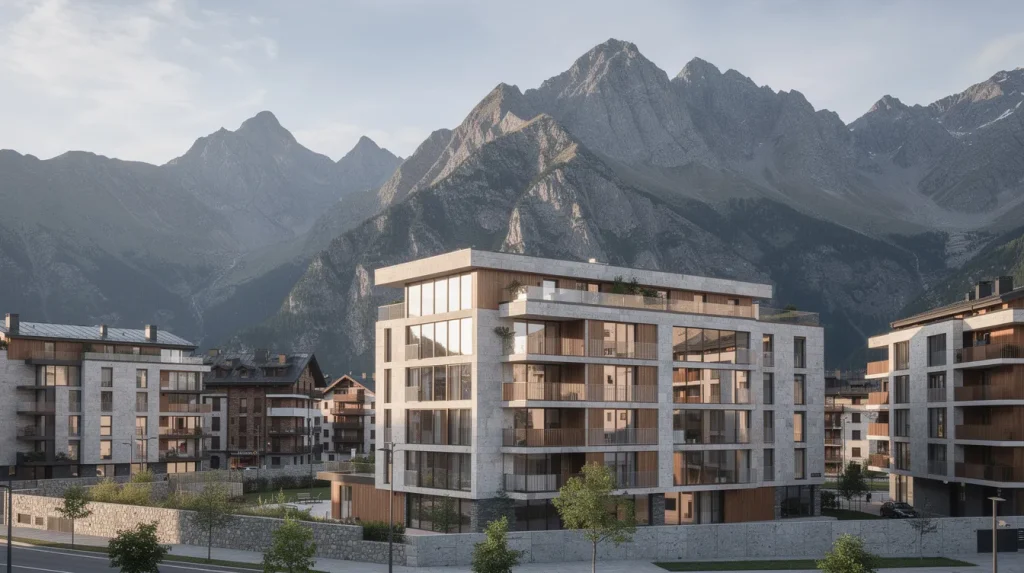
A plot of land that currently appears suitable for profitable development can change significantly in value when height restrictions are implemented and the required land dedication is increased. Andorra la Vella has announced two modifications with potential impacts on owners, developers, and buyers: buildings will be limited to a maximum height of seven stories, and the required land dedication will increase to 30%.
The announcement does not yet reveal how it will be applied to each plot, what planning will be affected, or what specific conditions will apply to new projects, replacement works, and rehabilitation actions.
Key data
- Maximum advertised height: 7 floors.
- New urban planning transfer announced: 30%.
- The specific application will depend on the planning and the corresponding regulations.
What has changed in the urban planning regulations of Andorra la Vella?
The Andorra la Vella City Council has announced that the maximum building height will be seven stories. The implementation of this measure will depend on current zoning regulations and the specific conditions of each plot of land.
The second new measure announced is the increase in the urban development allowance to 30%. This obligation could reduce the land or development potential available to the developer, depending on how it is specified in the planning and applicable regulations.
For a property owner, the announcement doesn't automatically mean their building has to be reduced in size. For a developer, it's also not enough to simply count the permitted floors and multiply them by the plot size. They will have to review the buildable area, loads, alignments, setbacks, and all other urban planning requirements.
The practical scope still requires documentary confirmation. A measure already incorporated into the regulations is not the same as an announcement pending development, approval, or implementation through specific instruments. This difference can change the timelines and feasibility of an operation.
What does it mean to limit buildings to seven floors?
The limit could affect new residential developments, mixed-use buildings, and projects intended to replace existing structures. A lower height could mean fewer apartments, less marketable space, or a different layout for common areas.
The figure of seven floors alone does not answer all the questions. It will be necessary to know how above-ground floors are counted, what treatment basements receive, and how technical elements, roofs, and possible exceptions are regulated. These details must be sought in the regulations applicable to each project.
In the city center, height restrictions could affect the landscape, density, and integration of buildings. More restrained zoning regulations can change the character of certain areas and limit the concentration of housing on plots with the greatest potential.
For a landowner, the economic implications are clear: if they previously expected to build more units and the project is now limited, the development value could decrease. However, the effect won't be the same everywhere. Location, plot shape, access, and local demand all play a role, just as much as the maximum number of floors.
The seven-story limit does not necessarily mean that all existing buildings must reduce their height. Its effect on each property will depend on the legal situation, permits, and the intended work.
What is urban planning transfer and why does it rise to 30%
Simply put, a land transfer is the portion of land or development rights that is tied to public urban planning obligations within a development project. This can relate to land, spaces designated for public use, or compensation stipulated by the urban planning framework.
A transfer of 30% means that a significant portion of the land or development rights would be allocated to these obligations. The percentage alone does not reveal the exact area the developer will retain or how the transfer will be implemented: that will depend on the applicable planning regulations and the characteristics of the plot.
For those preparing a development, moving from a lower lease amount to one of 30% could significantly alter the financial model. The project might have less saleable space or require a different layout to remain viable.
The transfer of ownership should be incorporated from the outset of any purchase analysis. Calculating the land price first and leaving the encumbrances until the end can lead to overvaluing the transaction. Construction, professional fees, taxes, financing, marketing, and administrative processing times must also be considered.
How the measure might affect homeowners and investors
The value of vacant lots, buildings awaiting replacement, and assets with potential for transformation could change with the new zoning regulations. A property that was advertised for its height potential might no longer be as profitable once the seven-story limit and the transfer of 30% are implemented.
Before buying, the investor should request a review of the buildable area, the number of possible units, and the actual marketable area. The built area does not automatically equate to the area that can be sold or rented.
A lower building height could reduce the buildable volume in some projects. At the same time, clearer planning can provide predictability and facilitate comparison between different plots. The opportunity will depend on whether the purchase price reflects the new conditions.
The financial impact depends on the location, zoning classification, size and shape of the land, existing encumbrances, and the planned project. Therefore, it makes no sense to value a transaction solely based on the price per square meter of the land.
Implications for those who want to buy a home in Andorra la Vella
The limitation may influence the future supply of housing, but it doesn't automatically guarantee a price increase. Demand, construction costs, financing, and how the regulation is ultimately implemented also play a role.
New housing may be more susceptible to planning changes, while existing housing should be assessed based on its condition, permits, and any planned renovations. Projects in the planning stage require further review: what is advertised commercially does not always match what will ultimately be authorized.
Before signing, a buyer should check the property's registration status, license, zoning classification, usable floor area, common elements, and any planned construction in the surrounding area. They should also inquire about any potential urban development charges and any modifications that might affect the property.
Will the seven-story limit drive up housing prices? Not necessarily. The measure may restrict some future supply, but its effect will depend on many factors and the final implementation of the regulation.
What should developers review before starting a project?
- Request an updated urban planning report for the plot.
- Confirm whether the measure is approved, in process or pending development.
- Recalculate the buildable area and the maximum number of floors.
- Incorporate the transfer of the 30% and the rest of the charges into the financial model.
- Review setbacks, occupancy, alignments, parking, accessibility and technical requirements.
- Consult architects, specialized lawyers and local technicians before signing or starting construction.
The urban planning report should be requested before committing to a purchase price. It is also helpful to prepare several scenarios: one with the most favorable building allowance, another with a more cautious interpretation, and a third that considers administrative delays or a smaller saleable area.
Is it a good time to invest in land or housing in Andorra la Vella?
The announcement alone doesn't allow us to conclude whether it's a good or bad time to invest. It could create risks for assets that depended on greater height, but it could also favor well-negotiated deals based on a clear urban planning situation.
Long-term property investment should be analyzed differently than real estate development. Those buying to live in need to prioritize the property itself, its location, and the actual costs. Those intending to develop must demonstrate that the project remains viable after applying the transfer of ownership, encumbrances, and deadlines.
A conservative financial scenario should include different levels of building density and various administrative timelines. The asset's liquidity and actual demand must also be analyzed, because selling a certain number of homes on paper does not guarantee a market for them.
Buying a cheap plot of land doesn't automatically make it a good deal. The price must be compared with the permitted development potential, the cost of planning obligations, and the time required to obtain permits.
Frequent questions
What is the maximum height of buildings in Andorra la Vella?
The announcement specifies a maximum height of seven stories. Specific conditions will depend on the plot of land and the regulations that ultimately apply.
What does the urban planning transfer of 30% mean?
This means that a portion of the land or development potential would be allocated to urban planning obligations stipulated by the administration. The details must be confirmed in the relevant planning documents.
Does the new regulation require reducing the height of existing buildings?
Not necessarily. The effect on each building will depend on its legal and urban planning status, existing permits, and the intended action.
How does the seven-floor limit affect developers?
It can reduce the volume or number of dwellings that can be built on certain plots. It also requires recalculating the profitability, burdens, costs, and timelines of the project.
Will the measure affect housing prices?
It can influence future supply, but it doesn't allow us to predict a rise or fall on its own. Demand, construction costs, financing, and regulatory implementation also play a role.
Conclusion: How to prepare for urban change
The two announced changes are clear: a maximum of seven stories and a zoning transfer of land from plot 30%. Their effect, however, will vary for each plot and each project. Location, zoning, encumbrances, and usable area will determine who gains and who loses development potential.
Before buying, selling, promoting, or renovating a property, it's essential to review the updated urban planning documentation and confirm the current regulatory status. A valuation based solely on commercial advertisements or historical building regulations can lead to overpaying.
To live, invest, or develop a project in Andorra, a personalized tax, real estate, and urban planning review allows you to make decisions based on more realistic scenarios. Andorra Insiders can help you analyze your situation before committing capital.
Sources
Last update: September 2026. The information in this article is verified with official sources from the Government of Andorra.